FROM SOLAR ENERGY TO WATER SECURITY IN WEST AFRICA
 PRY-RECS SOLAR WATER KIOSK
A solar panel is a visible sign of the green transition. A wind turbine represents progress towards cleaner energy. Green hydrogen offers possibilities for decarbonising selected industries. Yet, for communities facing everyday development challenges, the value of these technologies is ultimately determined by what they make possible.
Can clean energy help a school provide reliable access to safe drinking water? Can it support agricultural communities in managing water more sustainably? Can investment in renewable-energy infrastructure create opportunities for technical skills development, local enterprise and community participation?
These questions invite us to look beyond technology itself and consider the development outcomes it can support.
For West Africa, the green transition offers an opportunity to connect climate action with practical solutions in education, agriculture, water management and local economic development. This requires more than installing equipment. It calls for sound research, appropriate technology, effective management, community participation, and partnerships that support solutions throughout their operational life.
For PRY-RECS Consultancy Limited, this is the thinking behind a proposed initiative to develop solar-powered borehole water systems with purification and dispensing kiosks, particularly for senior high schools and underserved agricultural communities.
The ambition is straightforward: to explore how renewable energy can help address essential water needs while creating opportunities for wider community benefits.
Water Security Is Part of the Green Transition
Water and energy are closely connected. Pumping, treating, storing, and distributing water require energy, while unreliable or expensive energy supplies can make water services difficult to sustain.
Solar-powered water systems offer one possible response. UNICEF has documented the use of solar energy to pump water and supply schools, healthcare facilities and communities, including across West and Central Africa. These systems can reduce dependence on diesel-powered pumping, although their long-term effectiveness depends on sound design, water availability and appropriate operation and maintenance.
This experience demonstrates that renewable energy can support essential public services rather than being confined to electricity generation alone.
However, solar technology is not a complete solution in itself. A functioning system must be supported by a sustainable water source, appropriate treatment, safe storage, reliable dispensing facilities, and a clear plan for maintenance. Groundwater abstraction must also be assessed carefully to avoid placing additional pressure on already vulnerable water resources.
The green transition therefore requires an integrated approach, one that considers the source of the water, the energy used to deliver it, the safety of the supply and the people responsible for maintaining the system.
Senior High Schools: Bringing Sustainable Solutions Closer to Students
Schools provide an important starting point for exploring the connection between clean energy and water security.
Senior high schools bring together students, teachers, and support staff who depend on reliable access to drinking water throughout the school day. Where a school experiences unreliable water supplies, students may face unnecessary inconvenience, while school management must find ways to maintain essential services.
A proposed solar-powered water kiosk could help address this need by combining solar-powered pumping, suitable water purification, and accessible dispensing points. Depending on the school’s existing infrastructure and water requirements, the system could be designed as a standalone installation or integrated into an existing water supply.
The potential benefits extend beyond access to water. A well-designed school installation could also become a practical learning resource.
Students could learn about solar energy, water conservation, climate resilience, and the importance of maintaining shared infrastructure. With the involvement of technical partners and educators, the installation could support demonstrations or learning activities that connect classroom knowledge with real-world applications.
The objective would not be to turn every school into a technical training centre. Rather, it would be to demonstrate that sustainable infrastructure can also help make environmental knowledge tangible.
A school-based pilot would need to establish the water demand, assess the borehole or other proposed source, verify water quality, determine operating costs and agree on responsibilities for maintenance before installation.
The outcome should be measured not simply by the presence of a kiosk, but by whether students and staff can consistently access water that meets applicable drinking-water standards.
Agricultural Communities: Connecting Water, Livelihoods and Resilience
The same principle applies to agricultural communities, where water availability influences livelihoods, food production and local economic activity.
Farmers need appropriate water-management systems to respond to variable rainfall, dry periods and changing climatic conditions. Renewable energy can support selected agricultural applications, including water pumping, irrigation and post-harvest processing, where these uses are technically and economically viable.
For this reason, the PRY-RECS concept can be developed along two complementary pathways.
The first is the provision of safe drinking water through solar-powered water kiosks serving communities and appropriate public institutions.
The second is the exploration of complementary agricultural water-management solutions, such as solar-powered irrigation, water storage, efficient distribution systems and improved management practices.
These pathways should not be confused. A drinking-water kiosk is not, by itself, an irrigation system. Each intervention requires its own technical design, water assessment, operational arrangements and financing model.
Nevertheless, they can form part of a broader community resilience strategy. When planned responsibly, they can help connect renewable energy with human wellbeing, agricultural productivity and local development.
The objective is to identify solutions that respond to actual community needs rather than introduce technology simply because it is available.
From an Idea to a Practical Model: The PRY-RECS Water Kiosk Initiative
The proposed PRY-RECS solar-powered water kiosk initiative reflects a wider question: how can promising technologies be organised into practical services that communities can depend on?
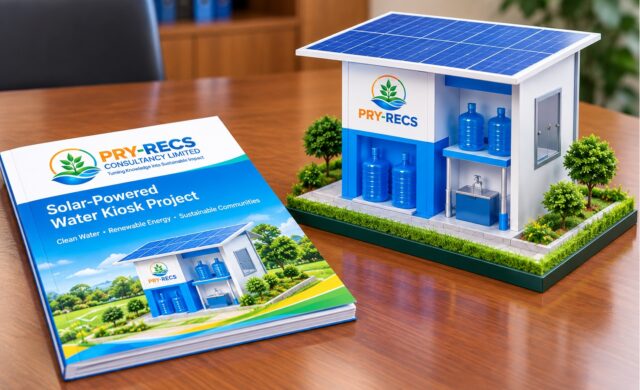
The concept envisages branded, solar-powered borehole water systems incorporating suitable purification and dispensing infrastructure. Senior high schools and agricultural communities would be among the priority settings for assessing potential pilot locations.
The initiative remains a concept to be developed through feasibility studies, technical collaboration and funding partnerships. Its design and scale would depend on site assessments, community requirements, water quality, groundwater availability and the resources secured for implementation.
A credible development pathway would begin with a limited number of carefully selected pilot sites. These could be used to evaluate technical performance, the cost of delivering water, user access, maintenance requirements and the suitability of the operating model.
The resulting evidence would inform decisions about improvements and potential expansion.
This approach matters because infrastructure projects can lose their value when maintenance, replacement parts, operating costs and management responsibilities are overlooked. A system that works at installation but fails to deliver a reliable service over time cannot fulfil its intended development purpose.
PRY-RECS therefore sees partnership development, research and practical implementation as important elements of the concept, rather than activities to be considered only after the technology has been installed.
Sustainability Must Include People and Institutions
A sustainable water initiative requires more than renewable energy and suitable equipment. It needs people and institutions capable of managing the service.
School authorities, community representatives, local technicians, water professionals and relevant public institutions could all have roles in planning and overseeing the proposed systems. Their responsibilities would need to be agreed before implementation.
Training local technicians could support routine maintenance and timely repairs. Community engagement could help establish transparent arrangements for access, feedback and accountability. Appropriate monitoring could track water quality, system downtime, water delivered, and the resources required to keep the service operational.
The World Health Organisation’s guidance on water safety planning for small community water supplies provides a useful foundation for identifying risks and managing drinking-water safety throughout the supply chain.
Financial sustainability is equally important. Depending on the selected model, operating expenses might be supported through institutional budgets, public programmes, grants, responsible private-sector participation or other appropriate arrangements. Any user charges, if considered, would need to reflect affordability, access and the project’s social objectives.
The appropriate model should be established through consultation and feasibility assessment rather than assumed in advance.
Partnerships Can Bridge the Gap Between Knowledge and Implementation
No single organisation can address the technical, financial and institutional dimensions of a regional water-security initiative alone.
Research institutions can contribute evidence and technical assessment. Renewable Energy and water-technology providers can support system design and installation. School authorities and local governments can help identify priority needs and coordinate implementation. Development partners, foundations, corporate social responsibility programmes and impact investors may be able to support feasibility studies, pilot installations, capacity development or subsequent expansion.
PRY-RECS Consultancy Limited is open to exploring memoranda of understanding, technical collaboration, joint programme implementation, knowledge exchange and co-development of proposals with suitable partners.
The aim is to create a framework in which different capabilities can be brought together around clearly defined outcomes.
For partners, a pilot programme could provide an opportunity to test an approach, document lessons and identify conditions for replication. For PRY-RECS, collaboration would help transform an early-stage concept into a technically sound, evidence-informed and potentially scalable initiative.
The wider ambition is to explore a model that can be adapted to different contexts across West Africa, rather than assume that one design will suit every school or community.
Measuring Impact Beyond Installation
The success of a green initiative should be judged by the quality and durability of the service it delivers.
For the proposed water kiosk initiative, relevant measures could include the number of functioning systems installed, the number of students and community members served, the availability and quality of drinking water, system reliability, maintenance response times and the affordability of access.
Environmental performance could be assessed through energy use, dependence on diesel or grid electricity where relevant, and responsible groundwater management. Capacity development could be measured through the number of local technicians trained and their ability to maintain the systems.
These indicators would help distinguish infrastructure outputs from meaningful development outcomes.
They would also generate evidence for future decisions about programme design, financing and potential regional expansion.
The principle is simple: an installation is a starting point. Reliable service, responsible management and demonstrable benefits are what give the investment its lasting value.
Conclusion: Turning Knowledge into Sustainable Impact
Africa’s green transition will be shaped not only by the technologies introduced, but by how effectively they respond to people’s needs.
Solar energy can contribute to more reliable water services. Schools can provide practical settings for connecting sustainable infrastructure with environmental learning. Agricultural communities can benefit from appropriately designed water-management solutions. Local skills, responsible financing and effective partnerships can help these interventions remain functional beyond their initial installation.
The proposed PRY-RECS solar-powered water kiosk initiative offers one pathway for exploring these connections in senior high schools and agricultural communities across West Africa.
Its promise will depend on evidence, careful planning, suitable technology and the willingness of partners to work together towards measurable outcomes. It will also depend on recognising that access to water is not simply an infrastructure issue. It is connected to education, livelihoods, public wellbeing and resilience.
For PRY-RECS Consultancy Limited, the opportunity is to help bridge research and implementation, climate ambition and practical solutions, and promising ideas and lasting impact.
Because the green transition must do more than change how we generate energy. It must help improve how people live, learn, work and build their futures.
Referencing:
UNICEF, Solar-Powered Water Systems.
WHO, Water Safety Planning for Small Community Water Supplies.
PRY-RECS Consultancy Limited
Turning Knowledge into Sustainable Impact.
We welcome discussions with prospective funders, technical partners, research institutions, school authorities, public institutions, and development organisations interested in exploring the feasibility and implementation of solar-powered water solutions for schools and agricultural communities in West Africa.